With Nigeria’s new tax law taking full effect from January 2026, you’ll agree that there’s been a great deal of confusion and this is not because taxation in Nigeria is a new concept but despite the prevalence of information resources in this day, misinformation still spreads like wild fire.
We’ve seen it everywhere from X threads to WhatsApp statuses and broadcasts, different Facebook think pieces sounding alarms and promoting panic. These myriad of think pieces have made it extremely difficult to separate substance from chaff.
To understand Nigeria’s new tax law, you first need to understand why people are confused.
Is the law complicated?
Is the policy direction unclear?
Is the tax law written in a foreign language?
Let’s slow everything down for a moment and find answers together to the most common questions FlipEx users ask about crypto, gift cards, bank transfers, narrations, and taxation in clear terms that explains Nigeria's new tax law overview with practical examples.
Here are popular FAQs on Nigeria’s new tax law and how it applies crypto, gift cards, and everyday life.
FAQ 1: Will I Be Taxed Just Because Money Enters My Bank Account?
No. Nigeria does not run a transfer tax system. The tax system is an income tax system. According Section 3 of the New Tax Law, “Tax shall be charged on income, profits or gains accruing to or derived by a person.”
Tax will not be charged on deposits, bank transfers, so if:
- Your friend sends you urgent 2k
- Your brother sends monthly upkeep
- Someone pays back a loan
- You move money between your own bank accounts
- You withdraw money from FlipEx to your bank
All of these are not income activities so you won’t get taxed.
FAQ 2: Do I Need a Tax Identification Number (TIN) to Open/Use a Bank Account?
No, you do not need a Tax identification Number (TIN) to open or use a bank account in Nigeria. You need a valid Bank Verification Number (BVN) and National Identification Number (NIN) for banking purposes.
The Tax Identification Number (TIN) is required for filing tax returns, taxpayer registrations and other tax compliance processes.
FAQ 3: Are Loans Taxable Under the New Tax Law?
No. When you take a loan, it is not money that you earn therefore, loans are not considered as an income activity under the law. If a bank, cooperative society, loan app etc., offer you a loan with some interest (income), they will be mandated to pay tax on the income generated after you repay your loan.
FAQ 4: Is Foreign Money (Remittances) Sent By Family and Friends Taxed in Nigeria?
Money sent from family and friends as support, gifts and for other reasons that will not generate income will not be taxed. If the money sent is for a service rendered, then it will be considered as income and subject to tax.
FAQ 5: Will I Pay Tax When I Receive Payment For Work From An International Company Or Client?
Yes, this qualifies as income so you will be mandated to pay tax when you receive your earnings in Nigeria.
FAQ 6: Will I Pay Tax To Federal, State and Local Government Bodies In Nigeria?
No. The New Tax Law corrects the problem of multiple taxation on the same income. Personal Income Tax will be paid to the State.
FAQ 7: Does the New Nigerian Tax Law Tax Crypto Automatically?
No. Crypto is not taxed automatically. You won’t get taxed simply because you hold some crypto. Crypto is recognized as a digital property under the law but it is only subject to tax when you earn profit from crypto transactions.
“Profits or gains from transactions in digital or virtual assets.”
— Nigeria Tax Act, 2025, Section 4(e)
If there is no profit, i.e., if you make a loss on your crypto transaction, there will be no tax.
Let’s make it practical.
CRYPTO TRANSACTION EXAMPLES
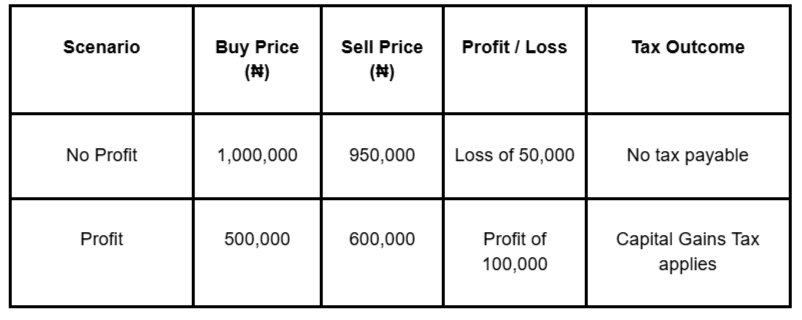
The ₦100,000 is what the law considers to be taxed not the total amount, only the profit.
FAQ 8: Are Gift Card Traders Taxed Under the New Law?
Yes, gift cards are also considered as digital or virtual assets under the tax law, but tax will only be paid on profits, not turnover.
Scenario: Gift Card Trading on FlipEx
- You buy a $100 gift card for ₦65,000
- You sell it for ₦72,000
- Profit: ₦7,000
Taxable amount = ₦7,000
This falls under:
“Profits or gains from any trade, business, profession or vocation.”
— Nigeria Tax Act, 2025, Section 4(a)
The total annual profit will determine the applicable tax rate.
FAQ 9: How Does Capital Gains Tax Apply to Crypto in Nigeria?
Capital Gains Tax (CGT) is one of the aspects of Crypto Tax under Nigeria’s New Tax Law. It applies when you:
- Sell crypto and make profit
- Exchange crypto for another crypto e.g., convert USDT to BTC then value of BTC increases. The increase in the value will be taxed.
- Convert crypto to Naira and make a gain.
Capital Gains Tax also has progressive tax bands that range from 10% to 30%. For individuals, profit made from crypto related activities that qualify for Capital Gains Tax are totalled with other income sources and then subjected to Personal Income Tax calculations.
FAQ 10: How Does Income Tax Apply to Crypto in Nigeria?
Income tax is applied directly to crypto earned as income, gain or profit. It applies when you:
- Earn crypto as payment
- Receive staking or mining rewards
- Tap tap tap to earn airdrops, tokens, etc.
- Trade crypto as a regular business
FAQ 11: Will I Pay Tax When I Receive Crypto and Gift Cards as Gifts?
Crypto, gift cards and other digital assets received as gifts will not attract any tax. Gifts are not taxable under the new tax law. However, when you exchange your crypto to Naira or redeem your gift cards to cash, the increase in the value of your gift cards or crypto will qualify as income and will be taxed using the Capital Gains Tax (CGT) provisions under the tax law.
FAQ 12: Do Bank Transfer Narrations Matter for Tax?
No. Bank transfer narrations are not considered for tax. Nigerian Revenue Service (NRS) will carry out assessments on:
- Income
- Profit
- Transaction Records
Nigeria Revenue Service (NRS) will not check:
- What you typed in your narration
- Whether you wrote “crypto”, “gift”, or “refund”
Your bank transfer narrations are great for record purposes and keeping track of your money trail. So, it’s a good practice to include them in your transfers so that you know where your money goes exactly.
FAQ 13: What If I Just Move Money Between My Own Accounts?
You will not pay tax when you move money between your bank accounts. As long as there is no income. When you send money from your FlipEx wallet to your bank account, this transaction will not be taxed. Bank charges including stamp duty fees and VAT on bank service charges will be charged.
FAQ 14: Can I Deduct Anything Before Paying Tax?
Yes. Section 20 of the new tax law allows specific reliefs and deductions, including:
- Pension contributions
- Insurance premiums
- Other statutory reliefs such as rent
This is especially helpful for salaried workers who also trade crypto or gift cards on FlipEx.
FAQ 15: What About the ₦25 Million Bank Reporting Threshold?
The New Tax Law mandates banks to report bank accounts that have a turnover of ₦25 million within each quarter. This is not a tax but information sharing between the banks and tax authorities. The NRS will be able to focus on people who get significant turnovers and maximise their resources.
FAQ 16: Will Small Businesses & Traders Pay Tax?
Small businesses and traders will only need to pay tax if their earnings reach certain thresholds. Earnings up to ₦800,000 are tax free and progressive tax bands apply to different income levels. The New Tax Law is advantageous for small businesses and low-income earners.
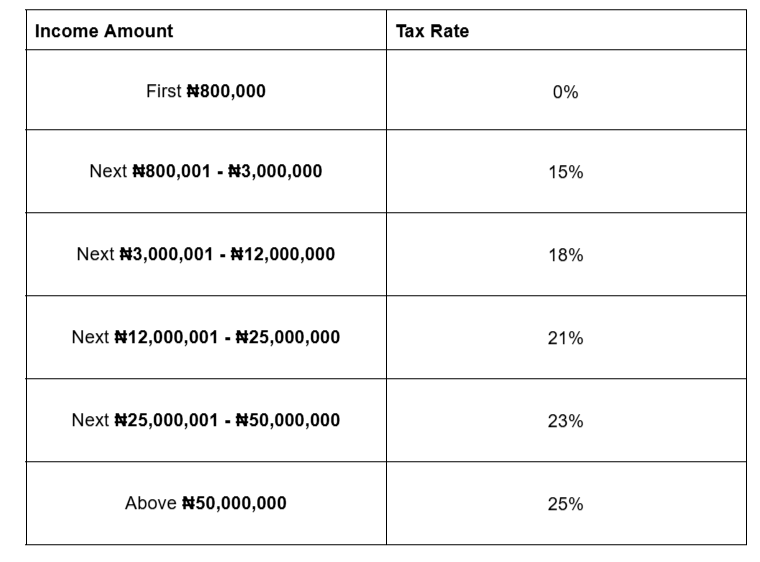
FAQ 17: What Are The Progressive Tax Rates In Nigeria?
The progressive tax rates under the new tax law are as follows:
FAQ 18: What Happens If I Don’t Comply & Pay My Tax?
Non-compliance can lead to:
- Late filing penalties
- Interest on unpaid tax
- Escalating fines for repeat cases
FAQ 19: How Can Tax Authorities Debit My Bank For Tax in Nigeria?
Section 60 of the new tax law gives tax authorities the ability to issue substitution notices to banks and other financial bodies to help them in recovering unpaid taxes. There is a process that this follows after the individual or company has failed to comply with tax payment processes.
FAQ 20: What If I Was Overcharged or Paid Too Much Tax?
As a Taxpayer, you have rights recognized by the New Tax Law that allows you to:
- Request a refund if excess tax was paid
- File disputes and seek resolutions
- Request Formal assessments and initiate appeal processes over tax decisions.
So, this creates a fair system between tax authorities and Taxpayers.
Bonus FAQ: How Should I Report Income For Crypto, Gift Card & Other Digital Assets?
It is important to keep purchase and sale records that match available data on public explorers such as Blockchain. When you convert your coins to Naira, you want to have a record of the transaction that highlights your profit or loss.
Understanding Nigeria’s New Tax Law Realities
We believe that we have been able to cover and provide answers to most of the popular questions on the new tax law in Nigeria. Nigeria’s new tax law is focused on taxing income and not about taxing every money that drops in your account.
The New Tax Law is already in effect and we can only hope that it provides a fair tax system and delivers on all other promises that the government has made so far.
If you have any other questions on Nigeria’s New Tax Law, you can always reach us on any of our support channels.
Let’s take out the fear, misinformation and focus on the realities of the tax law. This way, you can make income decisions with clarity.