USDT or BTC: Which Crypto Should You HODL in Nigeria?
Quick answer: Hold both, in proportions that match your goals. USDT for dollar stability and protection against Naira devaluation. Bitcoin for long-term growth potential. If you cannot afford to lose money, lean more towards USDT. If you have a time horizon of 2+ years, lean towards Bitcoin. Convert both BTC and USDT to Naira on FlipEx whenever you need cash.
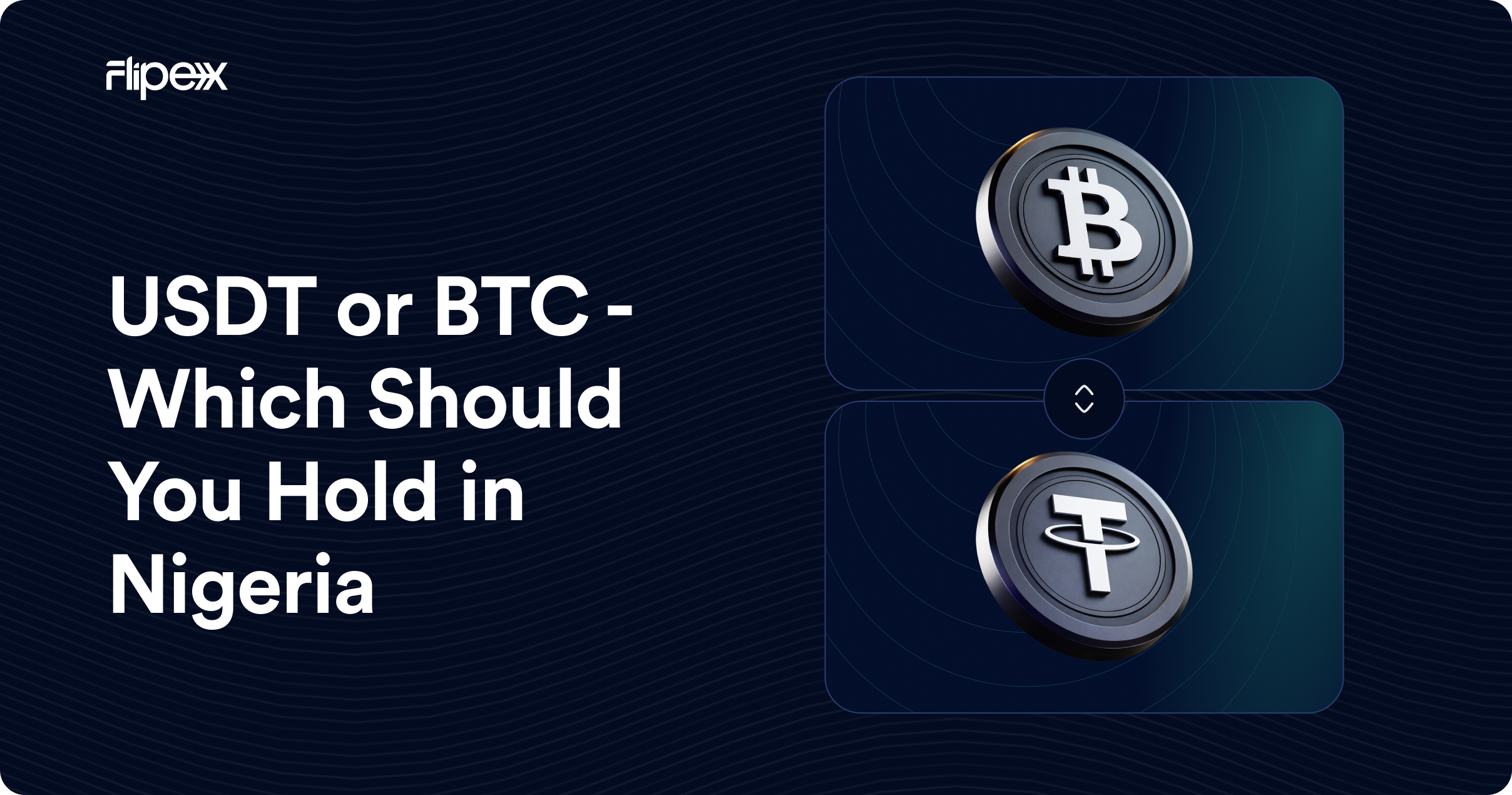
Should you HODL USDT or BTC? This is the most common question Nigerian crypto holders ask, and the answer is not a straight choice among either cryptocurrencies. USDT and Bitcoin serve completely different purposes in your financial life. Understanding what each one does well (and what it does not) is the key to making smart decisions.
Data from YouGov, 2026, suggests that 59% of crypto-active Nigerians hold USDT, making Nigeria the global leader in stablecoin adoption. Meanwhile, Bitcoin remains the most held cryptocurrency worldwide with a market cap exceeding $1.9 trillion. Both are available on FlipEx, and both can be converted to Naira instantly.
What Is USDT and What Does USDT Do Well?
USDT (Tether) is a stablecoin pegged 1:1 to the US Dollar. 1 USDT is always worth approximately $1. It does not go up dramatically and it does not crash. USDT's stability is its biggest strength.
USDT's Strengths for Nigerians
- Dollar preservation: While the Naira has lost over 70% of its value against the Dollar since 2023, USDT holds steady at $1. Holding USDT means holding dollars without needing a domiciliary account.
- Income protection: Freelancers and remote workers receiving USDT can hold their earnings in dollars and convert to Naira only when they need to spend. This avoids locking in a bad rate.
- Low cost transfers: Sending USDT on TRC-20 costs approximately $1, regardless of amount. Sending $100 or $10,000 costs the same.
- No volatility stress: You will never wake up to find your USDT has lost 20% overnight.
- Remittance alternative: Family abroad can buy USDT and send it to you for a fraction of the cost of Western Union or bank wire.
USDT's Weaknesses
- Zero growth potential: 1 USDT will always be $1. It will never be $2. It is a savings tool, not an investment.
- Centralised risk: USDT is issued by Tether Ltd, a company. If Tether ever faced insolvency or regulatory action, the peg could break. This is a low-probability but non-zero risk.
- Counterparty risk: Unlike Bitcoin which is decentralised, USDT depends on Tether maintaining sufficient reserves.
What is Bitcoin (BTC) and What Does Bitcoin (BTC) Do Well?
Bitcoin (BTC) is the original cryptocurrency. It is decentralised, scarce (only 21 million will ever exist), and has the longest track record in crypto — 15+ years. Bitcoin is volatile in the short term but has been the best-performing asset class over any 4+ year period in its history.
Bitcoin's Strengths for Nigerians
- Long-term growth: Bitcoin has gone from under $1 in 2010 to over $100,000 in 2024. Despite crashes of 50-80% along the way, it has always recovered and reached new highs.
- Decentralised: No single company or government controls Bitcoin. It cannot be frozen, seized, or inflated by any authority.
- Scarcity: Only 21 million Bitcoin will ever exist. As demand grows and supply is fixed, the price mechanism is structurally bullish over long timeframes.
- Institutional adoption: BlackRock, Fidelity, and other major institutions now offer Bitcoin ETFs. This is no longer a fringe asset.
- Inflation hedge: In countries with high inflation like Nigeria, Bitcoin has outperformed local currency savings over every 4+ year period.
Bitcoin's Weaknesses
- Extreme volatility: Bitcoin can lose 20-40% of its value in weeks. If you need the money in the short term, you could be forced to sell at a loss.
- Not a stable store of value: Your $1,000 in Bitcoin today could be $600 next month or $2,000. You cannot predict its movement with 100% accuracy.
- Requires patience: Bitcoin rewards long-term holders. Short-term traders often lose money.
- Transaction cost and speed: Bitcoin transactions are slower (10-30 minutes) and more expensive ($1-$5) than USDT on TRC-20.
USDT vs BTC Comparison
USDT Summary
- Value: Always ~$1
- Growth potential: None (by design)
- Risk of loss: Very low (peg risk only)
- Use case: Savings, payments, remittances, invoice settlement
- Volatility: Near zero
- Decentralisation: No — issued by Tether Ltd
- Supply: Unlimited — Tether mints as needed
- Transaction cost (to Naira on FlipEx): ~$1 (TRC-20)
- Best for Nigeria: Freelancers, savers, short-term dollar holders
- FlipEx support: Yes — 4 networks (TRC-20, ERC-20, SOL, BEP-20)
Bitcoin (BTC) Summary
- Value: Fluctuates daily — $60K to $100K+ range in 2024-2026
- Growth potential: Significant over 2+ year horizons
- Risk of loss: High in short term, low over 4+ years historically
- Use case: Investment, wealth building, inflation hedge
- Volatility: High — 5-20% swings in a week are normal
- Decentralisation: Yes — no single entity controls it
- Supply: Hard-capped at 21 million
- Transaction cost (to Naira on FlipEx): $1-$5 (Bitcoin network)
- Best for Nigeria: Investors, long-term wealth builders
- FlipEx support: Yes — Bitcoin network
The Nigerian Context: Why The Decision Between USDT and BTC Matters More Here
In a country like the UK or US, the choice between USDT and Bitcoin is purely an investment decision. In Nigeria, it is also a currency decision.
The Naira has depreciated from approximately N460/$1 in early 2023 to over N1,600/$1 in mid-2026. Inflation peaked at 26% in mid-2025 before easing to approximately 16% by mid-2026 according to the National Bureau of Statistics (NBS). For a Nigerian holding cash in Naira, purchasing power has been destroyed over these periods.
Holding USDT means holding dollars. Holding Bitcoin means holding an asset that has historically outperformed every fiat currency including the dollar. Both are better than holding depreciating Naira in a savings account earning 3-5% interest while inflation runs at 16%.
This is why 95% of Nigerian respondents in the 2026 YouGov Stablecoin Utility Report said they would prefer to receive payments in stablecoins over the Naira.
Recommended Allocation For USDT or BTC Based on Your Situation
- Cannot afford to lose any money: 80% USDT, 20% BTC — USDT preserves value. Small BTC position gives upside exposure without risking essentials.
- Stable income, can handle some risk: 50% USDT, 50% BTC — Balanced approach. USDT handles short-term needs, BTC handles long-term growth.
- Long investment horizon (3+ years), higher risk tolerance: 30% USDT, 70% BTC — Maximise growth exposure. USDT provides liquidity for opportunistic buying during dips.
- Freelancer receiving international payments: 60% USDT, 40% BTC — Hold USDT for stable invoice settlement. Convert a portion to BTC as a savings mechanism.
- Active trader: 70% USDT, 30% BTC — USDT is your trading base. BTC is your long-term hold outside of trading capital.
These are starting points, not fixed rules. Adjust based on your financial situation, expenses, and how comfortable you are with watching Bitcoin's price swing.
How to Buy and Hold USDT or BTC on FlipEx
- Open the FlipEx app
- Receive crypto from an external wallet or sell a gift card for Naira
- Use your Naira balance to buy USDT (TRC-20) or hold received BTC
- Both assets sit in your FlipEx wallet until you choose to sell
- Convert either to Naira at any time by tapping Sell Crypto
- Withdraw Naira from your crypto sale to any Nigerian bank account
Frequently Asked Questions
Is USDT safer than Bitcoin?
In terms of price stability, yes. USDT does not go up or down. But USDT has its own risks — it is centralised and depends on Tether Ltd maintaining reserves. Bitcoin has no single point of failure but its price is volatile. 'Safer' depends on what risk you are measuring.
Can I hold both USDT and BTC on FlipEx?
Yes. Your FlipEx wallet holds multiple assets simultaneously. You can hold USDT and BTC at the same time and sell either for Naira independently.
Which is better for receiving freelance payments?
USDT. When a client pays you $500 in USDT, you receive exactly $500 regardless of market conditions. If they pay in Bitcoin, the value could change 5-10% before you convert to Naira.
Should I convert my Naira savings to USDT or BTC?
If you need the money within the next 12 months, USDT. If you can leave it untouched for 2+ years, a mix with more Bitcoin. Never put money into Bitcoin that you might need in the short term.
What happens if USDT loses its peg?
If USDT ever lost its $1 peg, holders would lose value. This has happened briefly (USDT dropped to $0.95 in 2022 during the Terra/Luna crash) but recovered within hours. The risk is low but not zero. Diversifying across USDT and BTC reduces this risk.